A commercial van powered by a hydrogen internal combustion engine has spent time both on a chassis dynamometer at UC Riverside and on public roads, where researchers measured how its emissions changed under real driving conditions.
For Georgios Karavalakis and his research team at UC Riverside’s Center for Environmental Research and Technology, or CE-CERT, the testing is one piece of a much larger effort to understand how hydrogen engines could perform in transportation applications.
That larger picture came into focus in Detroit this month.
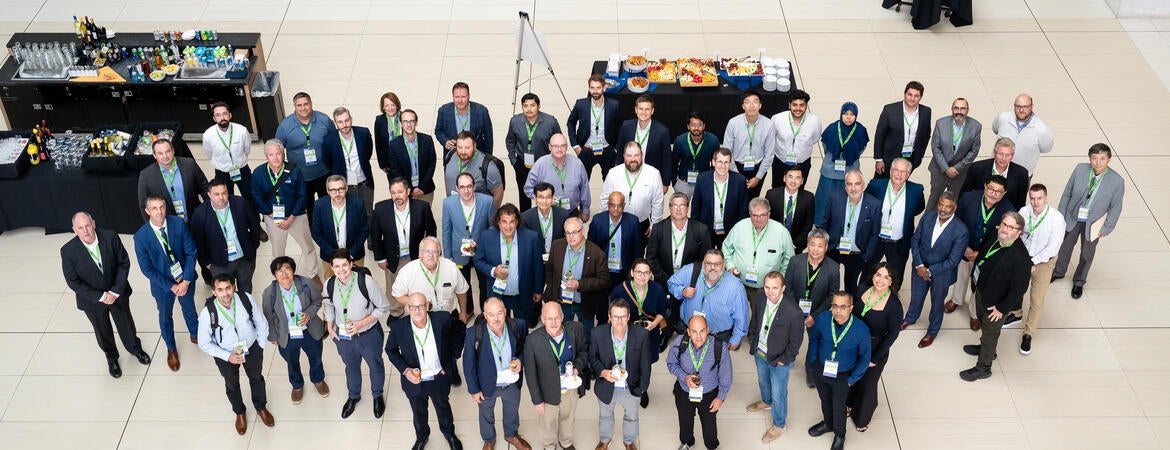
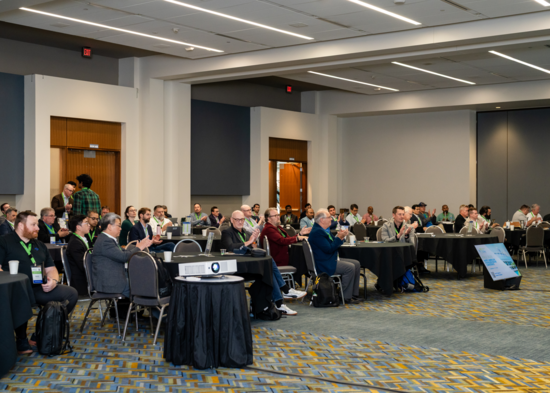
Karavalakis joined researchers, engineers, manufacturers, policymakers, and other hydrogen experts for the Fall 2026 North American Hydrogen Engine Conference, held Sept. 15-16 at Huntington Place. The two-day conference drew 100 attendees representing more than 60 companies, universities, government agencies, national laboratories, and research organizations.
The event was organized by the Hydrogen Engine Alliance – North America, or H2EA-NA, a collaboration co-led by Karavalakis at UCR and University of Michigan professor André Boehman.
Detroit was also part of the conversation. Vince Keenan, Head of Innovation Engagement for Mayor Mary Sheffield’s Office of Mobility Innovation, welcomed attendees on the opening morning. His participation reflected the city’s growing involvement in conversations around hydrogen, mobility, and new transportation technologies.
The conference’s two keynote speakers approached hydrogen from different points in the energy system. Joseph G. Spakowski of PHINIA opened Members Day with “H2 ICE Is Ready Now!,” drawing on the company’s work in hydrogen fuel systems, vehicle development, and testing. The following morning, University of Michigan professor Brian Ellis, co-director of the MI Hydrogen initiative, examined geologic hydrogen and opportunities for underground hydrogen storage in Michigan.
Together, the keynotes helped frame a conference that extended well beyond the engine itself. Discussions covered combustion science, vehicle emissions, fuel production and storage, infrastructure, economics, policy, and safety.
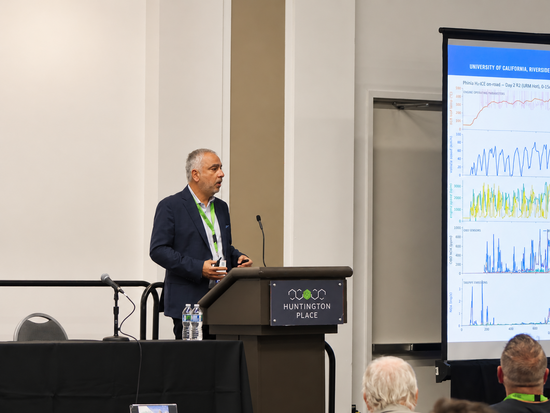
Karavalakis, a professor of chemical and environmental engineering in UCR’s Marlan and Rosemary Bourns College of Engineering, presented CE-CERT’s evaluation of a commercial H2-ICE vehicle during the conference’s second day.
Unlike a fuel cell vehicle, which uses hydrogen to generate electricity, an H2-ICE vehicle burns hydrogen directly in an internal combustion engine. Hydrogen contains no carbon, but researchers still need to characterize other emissions produced during combustion and understand how engine performance changes under different operating conditions.
CE-CERT’s work compared the vehicle under controlled laboratory driving cycles and on-road operation, building on the center’s experience evaluating emerging transportation technologies under conditions designed to reflect how vehicles are actually used.
University of Michigan professor Margaret Wooldridge added another research perspective, examining cases in which hydrogen ignition behaves differently than computer models predict. Her work looks at how temperature, pressure, fuel mixture, and other conditions influence ignition, helping engineers better understand the combustion behavior their models are intended to reproduce.
The conversation then moved outward from the engine.
Thomas Briggs of Southwest Research Institute presented an analysis of hydrogen options for a refuse truck fleet in San Antonio, including the costs associated with producing, transporting, storing, and dispensing hydrogen alongside the costs of operating the vehicles themselves.
Tarek Abdel-Baset of FORVIA discussed work in the Detroit region to develop hydrogen infrastructure that can begin with smaller applications and expand as demand grows. Return-to-base fleets, whose vehicles regularly return to the same location, offer one way to introduce hydrogen vehicles without first building an extensive public fueling network.
Safety and standards were another part of that broader picture. Livio Gambone of Hydrogenium Consulting discussed how hydrogen storage, leak detection, fueling systems, and vehicle components are designed and tested for conditions they may encounter during everyday use.
For Karavalakis and Boehman, bringing those perspectives together is part of the purpose of H2EA-NA. Researchers may be studying combustion or emissions while manufacturers work on vehicle integration, infrastructure developers focus on fuel availability, and public agencies consider the conditions needed for deployment. Their decisions increasingly intersect.
The Detroit conference gave those groups two days to share results, compare approaches, and connect research underway in laboratories with the practical questions facing hydrogen technologies outside them.
For CE-CERT, it also brought work conducted in Riverside into a broader discussion about how hydrogen engines and the systems around them are developing together.
The Fall 2026 North American Hydrogen Engine Conference was supported by PHINIA, Daimler Truck North America, Sacramento Metropolitan Air Quality Management District, South Coast Air Quality Management District, and OPmobility.
Let us help you with your search