EFR Testing Facilities
CE-CERT provides two complementary testing programs: emissions measurement and analysis, and controlled vehicle and powertrain evaluation.
Industry, government, and academic partners can work with the Emissions and Fuels Research team to evaluate pollutants, fuels, sensors, engines, electric vehicles, and advanced transportation technologies in laboratory and real-world settings.
Testing That Supports Real-World Impact
Characterize gaseous pollutants, particulate matter, toxic compounds, and sensor performance.
Run repeatable light-duty, heavy-duty, engine, and electric-drive testing under controlled conditions.
Connect laboratory-quality instruments with on-road, off-road, marine, and stationary applications.
Generate science-based data for technology development, regulatory work, and research partnerships.
Emissions Testing Laboratories
These capabilities measure gaseous pollutants, particulate matter, toxic compounds, and other emissions from equipment, vessels, engines, sensors, and commercial processes.
01 Cooking Emissions Test Kitchen Capture and analyze emissions from commercial and non-commercial cooking equipment.
Reducing Emissions Through Cleaner Kitchens
Emissions from commercial and non-commercial kitchens can have a substantial impact on the quality of our air. In addition to cooking by-products such as grease, smoke, and heat, cooking methods such as charbroiling are known to generate large amounts of particulate matter. As a result, several air quality agencies in California are exploring the possibility of requiring cooking operations to install control devices. CE-CERT’s test kitchen facility is designed to capture and analyze the emissions generated by a variety of cooking equipment, providing researchers with data critical to the development of policy around the manufacturing, maintenance, and use of such equipment.
02 Marine Emissions Testing Laboratory Measure gaseous pollutants and particulate matter from marine engines under real operating conditions.
Marine and Vessel Emissions
CE-CERT’s marine laboratory measures carbon monoxide, carbon dioxide, oxygen, nitrogen oxides, sulfur oxides, and particulate matter from raw and diluted exhaust using methods aligned with ISO 8178 and federal measurement protocols.
The facility also includes a marine two-stroke engine test platform for evaluating marine fuels, aftertreatment systems, and emerging technologies.
03 Mobile Emissions Laboratory Collect certification-grade measurements from mobile and stationary engines in the field.
Measuring the Emissions of Large Stationary Engines
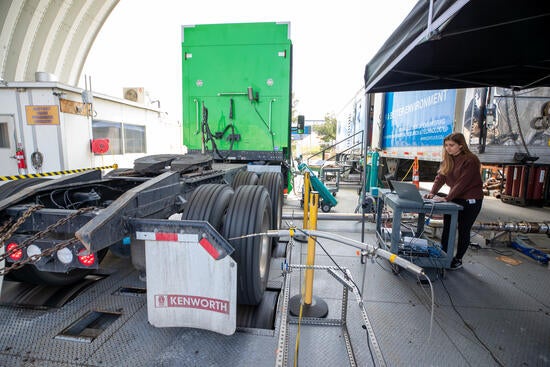
UCR’s Mobile Emission Laboratory (MEL) connects to the total exhaust of a diesel or alternative-fueled heavy-duty engine to collect certification-grade emissions measurements. The lab is housed inside a tractor-trailer, so it can be connected to a heavy-duty truck cab and collect measurements while going down the road, transported to any facility to measure and certify large stationary engines, or used in conjunction with UCR's or others' heavy-duty engine or chassis dynamometer. MEL collects information on a wide range of pollutants including criteria, toxics, NH3, and particle size and number. MEL is 1065 compliant and is validated with the California Air Resources Board’s and Southwest Research Institute’s heavy-duty diesel laboratories.
04 OSAR Laboratory Create controlled exhaust conditions for sensor, catalyst, and aftertreatment development.
Simulating Power Plant Exhaust Systems
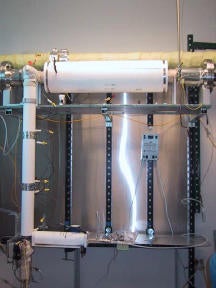
CE-CERT, in partnership with EmiSense Inc. LLC, developed a simulation laboratory to research onboard sensors and other needs for exhaust simulation. This laboratory is designed to operate up to 700 C, high water concentrations of up to 15% water, and various concentrations of SO2, NO, NO2, NH3, HC’s and O2, and various other species of interest. The laboratory has excellent thermal management controls and is easily configured for various research projects.
This laboratory is ideal for sensor aging, evaluation, and characterization. In addition, it can be used for catalyst formulation, exhaust sensor development, durability studies, and other development projects where controlled exhaust conditions are desired. There are three main elements of the laboratory mass flow control of the gaseous species injection, water injection and steam generation, and heater controls.
The laboratory includes a high (up to 40 lpm) and low flow (up to 2 lpm) operation, an integrated FTIR, Minicast soot generator, automated thermal cycling test stand, IR camera for surface temperature scanning (1000 C), Solartron EIS measurements (impedance and frequency response), oscilloscope to view electrical signals, and a PG350 gas analyzer (NO, NO2, CO, CO2, and O2).
Gaseous water is introduced into the blended sample gas stream in order to provide the desired water content. The water generation system consists of a water reservoir, a graduated burette, a positive displacement pump, and a heating system. The temperature of the sample cell is controlled through a heater capable of maintaining a desired gas temperature up to 750ºF (400ºC) within the cell path.
Services and Applications
- Sensor aging and characterization
- Catalyst and aftertreatment development
- Automated thermal cycling
- Controlled gas, water, and temperature profiles
05 Portable Emissions Measurement Systems Measure gaseous and particulate emissions from vehicles and equipment during actual operation.
Measuring Emissions for On-road and Off-road Applications
CE-CERT has a fully 1065-approved gaseous and PM PEMS system for on-road and off-road applications. The PEMS utilizes the AVL M.O.V.E. system for gaseous emission measurements and the AVL 494 system for PM measurements. The AVL M.O.V.E. is equipped with a non-dispersive ultraviolet (NDUV) analyzer for measuring oxides of nitrogen (NO and NO2), a non-dispersive infrared (NDIR) analyzer for measuring CO and CO2, and a flame ionization detector (FID) for measuring total hydrocarbons (THC). The gaseous data is measured as a concentration and is time-aligned and flow-weighted to the exhaust flow for total mass reporting. All time alignment and flow weighting is performed as part of the post-processor systems for both PEMS. The exhaust flow meter is integrated with the gaseous PEMS and is designed to work with a wide range of exhaust flows and dynamics of transient vehicle testing. The exhaust flow meter uses differential pressure as its measurement principle.
Vehicle Testing Laboratories
CE-CERT’s vehicle laboratories support repeatable evaluation of battery electric, plug-in hybrid, hybrid electric, fuel-cell electric, and conventional vehicle and engine technologies.
01 Heavy-Duty Chassis Dynamometer Simulate road load and inertia for medium- and heavy-duty vehicles under repeatable conditions.
Simulating Exacting Road Load and Inertia Forces
CE-CERT is home to a heavy-duty tandem axle truck chassis dynamometer in conjunction with Mustang Dynamometer. The development of the chassis dynamometer design was based on target vehicles in the medium- to heavy-duty diesel vehicle range. This high-performance 48” Electric Chassis Dynamometer has dual direct-connected, 300 Hp AC Motors individually attached to each roll set (model MD-AC/AC-300.48/300.48-45,000lb-HD-TANDEM). The dynamometer is capable of simulating exacting road load & inertia forces to a vehicle operating over a range of different driving conditions, including highway cruise, urban driving, and other typical on-road driving conditions, with the design based on 17 different drive cycles. The robust dynamometer can continuously absorb/motor loads in excess of 600 HP from 45 to 80 mph and intermittently absorb/motor loads in the range of 1,200Hp. It is able to perform vehicle inertia simulation across a vehicle weight range of 10,000 to 80,000 lb. CE-CERT’s Mobile Emissions Laboratory (MEL) is used directly in conjunction with this facility for certification-type emissions measurements.
02 Heavy-Duty Engine Dynamometer Evaluate engines, alternative fuels, aftertreatment systems, and advanced diesel technologies.
Evaluating Diesel Devices, Alternative Fuels, Research, and Technologies
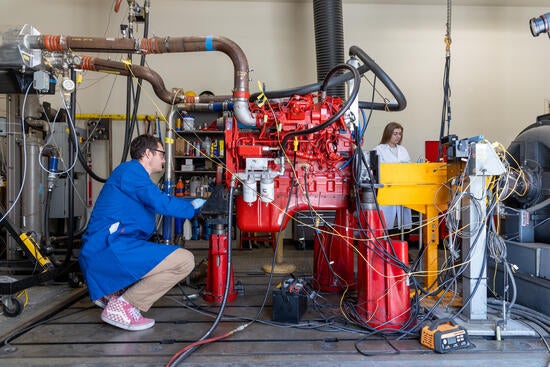
CE-CERT’s Heavy-Duty Engine Dynamometer Test Facility is designed for a variety of applications including verification of diesel after-treatment devices, certification of alternative diesel fuels, and fundamental research in diesel emissions and advanced diesel technologies. The engine dynamometer facility components were provided as a turnkey system by Dyne Systems of Wisconsin. CE-CERT’s Mobile Emissions Laboratory (MEL) is used directly in conjunction with this facility for certification-type emissions measurements. The facility is recognized by CARB for conducting engine dynamometer testing and has been the cornerstone of CARB’s study of biodiesel as part of the Low Carbon Fuel Standard (LCSF). The test cell is equipped with a 600 horsepower (hp) GE DC electric engine dynamometer that was obtained from the EPA’s National Vehicle and Fuels Emission Laboratory in Ann Arbor, MI. The dynamometer is capable of testing approximately 85% of the engines used in on-road applications and will primarily be used for engines in the 300 to 600 hp range. A charge air conditioning system was obtained from Dyno Air of North Carolina to provide temperature/humidity control for the engine intake air with an accuracy of ±2°C from the setpoint.
03 Light-Duty Chassis Dynamometer Measure exhaust emissions and vehicle performance under controlled, real-world-representative conditions.
Measuring Exhaust Emissions Under Real-World Driving Conditions
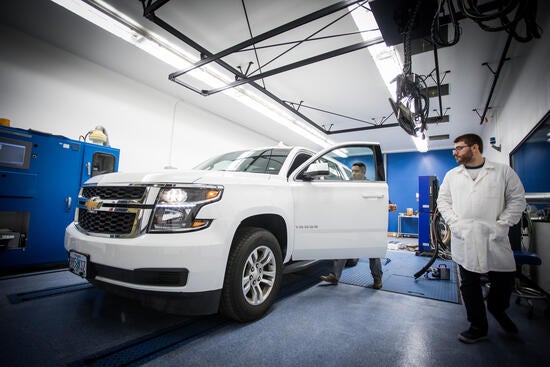
AVL Test Systems Inc., in partnership with CE-CERT, has completed the installation of a state-of-the-art laboratory for measuring exhaust emissions under conditions that are representative of real-world driving conditions, commissioned in January 2020. The facility meets all CFR 1065/1066 requirements and is located within five miles of the new CARB Southern California headquarters. CE-CERT’s laboratory was designed to be nearly identical to the new test facility at CARB (the same equipment, designs, software, configurations, and firmware). The new CE-CERT LDL facility will be utilized to support advanced low-emissions vehicles, hybrids, and electric vehicle performance and will be a leading research and training tool for Southern California. The laboratory includes AVL’s iGEM test cell automation system, capabilities for ultra-low emissions testing (SULEV[20/30], PZEV, other low emissions options), advanced non-regulatory data collection, real-time PM (soot), fuels, blending, fuels impact, and on-road testing. As part of this partnership with AVL, additional in-house expertise will be available through CE-CERT, such as combustion analysis tools and other specialized equipment within the AVL portfolio.
04 EV Data Acquisition System Monitor vehicle performance, battery state of charge, voltage, current, and energy use in real time.
Real-Time Electric Vehicle Monitoring
Working with CARB and the California Energy Commission, CE-CERT has developed and utilizes specific testing protocols for EVs. In addition to standard vehicle performance measurements of velocity and acceleration, CE-CERT is able to measure battery SOC, system voltage and current, energy efficiency per mile (kWh/mile), and gradability.
Work With CE-CERT
Testing programs can be structured around technology validation, sponsored research, regulatory support, or sales-and-service work.
Define the Scope
Share the technology, test article, measurements, schedule, and decisions the data must support.
Build the Test Plan
CE-CERT identifies the appropriate laboratory, instrumentation, operating conditions, and reporting approach.
Test and Deliver
The team conducts the work, completes quality assurance, and provides the agreed data, analysis, and reporting.
Discuss Pricing and Lab Availability
Contact CE-CERT to discuss testing needs, scheduling, scope, facility availability, and the service option best aligned with your project.