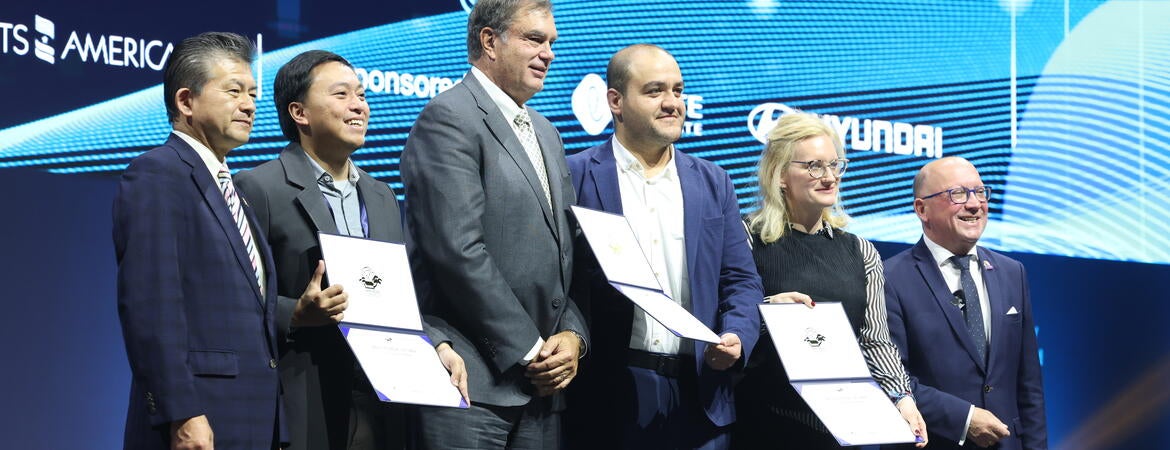
A joint research team from the University of California, Riverside and Toyota Motor North America (TMNA) InfoTech Labs has earned the Best Scientific Paper Award at the 2026 Intelligent Transportation Systems (ITS) World Congress in Gangneung, South Korea, for developing an artificial intelligence-based approach that could help cities reduce traffic congestion and vehicle energy consumption.
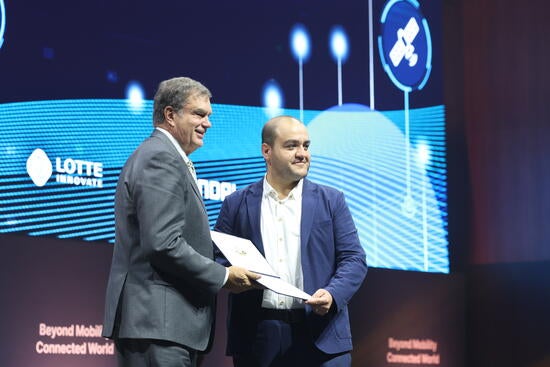
The award-winning paper, "Network-Level Co-Optimization of Traffic Signals and Vehicle Trajectories for Connected and Automated Vehicles via Multi-Agent Reinforcement Learning: A Manhattan Network Case Study," was co-authored by researchers affiliated with UCR's Center for Environmental Research and Technology (CE-CERT), including doctoral students Changxin Wan and Ziyan Zhang, and research faculty Peng Hao, Guoyuan Wu, and Matthew Barth, together with InfoTech Labs researchers Seyhan Ucar and Yongkang Liu. The research was supported by TMNA InfoTech Labs.
The recognition highlights the researchers' efforts to address a persistent challenge in urban transportation. Traffic signals and vehicles often operate independently, limiting opportunities to improve traffic movement and reduce unnecessary energy use across entire road networks.
Their solution uses multi-agent reinforcement learning that enables multiple decision-making systems to coordinate their actions. The approach groups intersections according to traffic patterns, allowing signal controllers to adjust green-light timing cooperatively. At the same time, connected and automated vehicles receive speed guidance to help them pass through intersections without unnecessary stops.
In computer simulations of a calibrated Manhattan road network, the system increased vehicle throughput by 27.3%, improved average vehicle speeds by 24.1%, reduced energy consumption by 6.1%, and cut idling time by 9.1% compared with a conventional traffic signal timing method.
These results demonstrate the potential value of coordinating traffic signals and vehicle movement rather than managing them separately. Although the system has been evaluated in simulations rather than on public roads, the findings offer a possible approach for improving traffic efficiency without expanding existing road infrastructure. The award recognizes the joint research efforts of UC Riverside and TMNA InfoTech Labs to advance intelligent transportation technologies. The views and conclusions expressed in the paper are those of the authors and do not necessarily reflect the views of TMNA or its affiliates.
Let us help you with your search