
Estimates of what asphalt pavement releases into the atmosphere have varied widely. Part of the challenge is recreating what happens to a road after construction, as pavement heats in the sun, cools overnight, and ages over years of service.
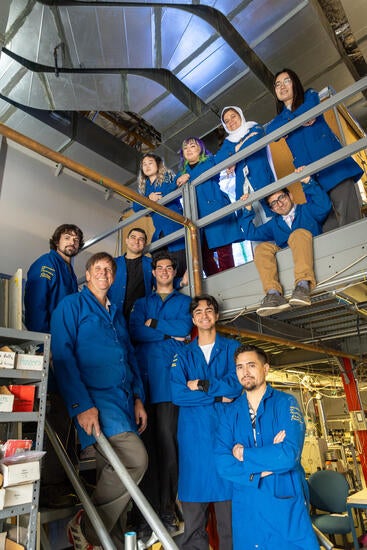
David Cocker, principal investigator of the Atmospheric Processes Laboratory at UC Riverside’s Center for Environmental Research and Technology (CE-CERT), and his Ph.D. students examined those conditions using compacted asphalt in controlled laboratory experiments and outdoor testing.
The research was funded by the Asphalt Institute, the National Asphalt Pavement Association (NAPA), the European Association of Bitumen Producers (Eurobitume), and the State Asphalt Pavement Associations Inc. (SAPA).
Cocker, who is also a professor and chair of UCR’s Department of Chemical and Environmental Engineering, conceived and designed the study and supervised the research. Huawei Li, the study’s first author and one of Cocker’s Ph.D. students, led the indoor experiments, contributed to outdoor data collection and sample processing, and analyzed and interpreted the data.
Published in the American Chemical Society’s Environmental Science & Technology Air (ACS ES&T Air), the study found that temperature, aging, sunlight, and the physical structure of pavement can affect emissions. The researchers say those factors should be considered when estimating asphalt pavement emissions over time.
“This research brought together academia and industry to better understand potential sources of atmospheric emissions from compacted roadways,” Cocker said. “By combining controlled laboratory testing with measurements from in-place pavements, we were able to evaluate emissions using a comprehensive approach that reflects the conditions pavements experience in the environment.”
At CE-CERT, the researchers tested compacted hot mix asphalt at different temperatures and as the material aged. They also studied how ultraviolet light affected the formation of secondary organic aerosol, particles that can form in the atmosphere when emitted gases undergo chemical reactions.
Other specimens were exposed outdoors to summer conditions in Inland Southern California, where they heated during the day and cooled at night. Under those conditions, concentrations of the volatile and intermediate-volatility organic compounds researchers were measuring were generally indistinguishable from background levels and below the study’s detection limits.
The laboratory experiments helped explain how changing conditions can affect those results. Emissions increased with temperature and declined as the asphalt aged. Ultraviolet exposure increased secondary organic aerosol formation under controlled conditions.
The physical structure of pavement mattered, too. Asphalt binder coats and binds aggregate within a compacted structure rather than sitting fully exposed to the atmosphere. Tests using specimens of different thicknesses indicated that the movement of compounds through the material influences how much is released and for how long.
Using a model that accounted for emissions declining as pavement ages, the researchers estimated that compacted asphalt would lose about 0.00002% of its mass through emissions over 20 years. That lower-bound estimate was more than 250 times lower than a lifetime estimate reported in an earlier study.
The researchers caution that comparisons among studies depend on how asphalt is prepared and tested and on the assumptions used to project emissions over time. Their findings point to the need for models that better account for the conditions pavement experiences throughout its service life.
Additional field measurements and testing across different seasons could help researchers refine those estimates further.
The study, “Primary and Secondary Emissions from In-Service Compacted Hot Mix Asphalt Pavement,” is published in ACS ES&T Air. Read the study at https://pubs.acs.org/aeacd5/article/doi/10.1021/acsestair.6c00071/5445687/Primary-and-Secondary-Emissions-from-In-Service.
Let us help you with your search