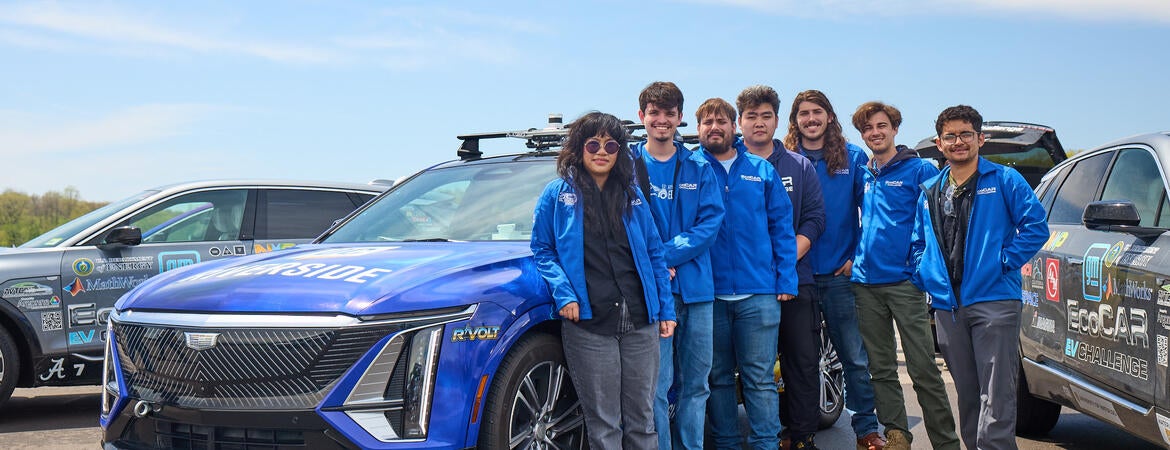
The UC Riverside EcoCAR team traveled to Michigan in May for the fourth and final competition of the EcoCAR EV Challenge, closing out four years of work on R’VOLT, the team’s reengineered Cadillac LYRIQ.
The trip was the last major milestone in a project that began with design plans and technical reviews and grew into a full vehicle development effort at the Center for Environmental Research and Technology (CE-CERT). Over the course of the competition, UCR students worked through the demands of building, testing, and refining an advanced electric vehicle while balancing coursework, deadlines, team responsibilities, and industry expectations.
The EcoCAR EV Challenge asked university teams to redesign a 2023 Cadillac LYRIQ with advanced propulsion, connectivity, and automation technologies. For UCR, that work included developing a high-efficiency drivetrain and Level 2 connectivity and automation features such as lane keeping and cooperative adaptive cruise control.
Those systems took years to move from plans into the vehicle. Students worked across technical subteams, managed documentation, prepared presentations, addressed integration issues, and adjusted their approach as the vehicle moved through each stage of the challenge. By the final year, the team’s focus had shifted toward validation: making sure R’VOLT could perform reliably in front of judges, sponsors, and competing teams.
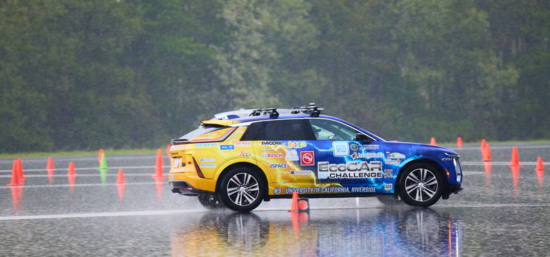
The final competition was held May 11-21 in Michigan and included 13 teams from across North America. During the first stage, teams brought their vehicles to the General Motors Milford Proving Ground for a week of testing. R’VOLT was evaluated in events focused on energy use, drivability, connected vehicle functions, adaptive cruise control, and consumer appeal.
The UCR vehicle performed especially well in energy efficiency and drivability. Those results reflected several years of work on the vehicle’s powertrain, controls, and overall driving experience.
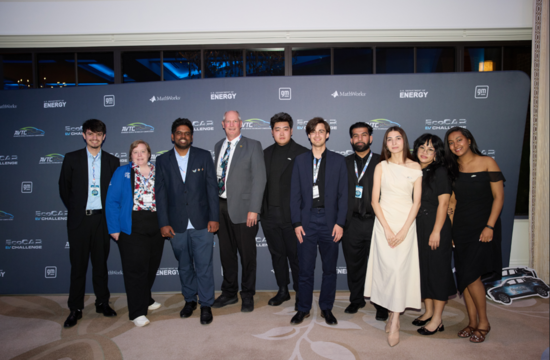
After the vehicle events, the team moved into presentations and sponsor-judged activities. Students presented their work in areas including program management, communications, and technical innovation. These sessions gave the team a chance to explain how they organized the project, what they learned during vehicle development, and how they responded to challenges over the four-year program.
UCR also earned 1st Place in Social Media Management, one of the team’s major highlights from the final competition. The award recognized the team’s communications work throughout the year, including its efforts to share technical progress, student experiences, and competition updates with campus and external audiences.
Although UCR did not place among the top overall point winners, the team left Michigan with extensive hands-on experience in automotive technology, systems engineering, team communication, and project execution. Students worked with a full vehicle platform and gained experience that closely reflects the pace and complexity of industry projects.
The EcoCAR program also supported CE-CERT’s broader work in student training and sustainable transportation research. Hosted at CE-CERT, the team had access to a research environment focused on intelligent mobility, vehicle systems, clean transportation, and applied engineering.
R’VOLT has now returned to CE-CERT, where it will continue to be used for research over the next several years. The vehicle will support future work in connected and automated vehicle technologies, electric vehicle systems, and energy-efficient transportation.
For the UCR EcoCAR team, the final competition ended a demanding four-year effort. For CE-CERT, R’VOLT remains a working research platform and a record of what students can accomplish through sustained, hands-on engineering work.
Let us help you with your search