What does the air we breathe look like during a daily commute? A new CE-CERT study is helping answer that question by tracking air quality conditions across the transportation environments people experience every day, from rail platforms and buses to airport walkways and urban streets throughout Southern California.
Researchers at the University of California, Riverside’s Center for Environmental Research and Technology (CE-CERT) are advancing understanding of air quality conditions in transportation-related urban environments through a mobile monitoring study conducted across Southern California.
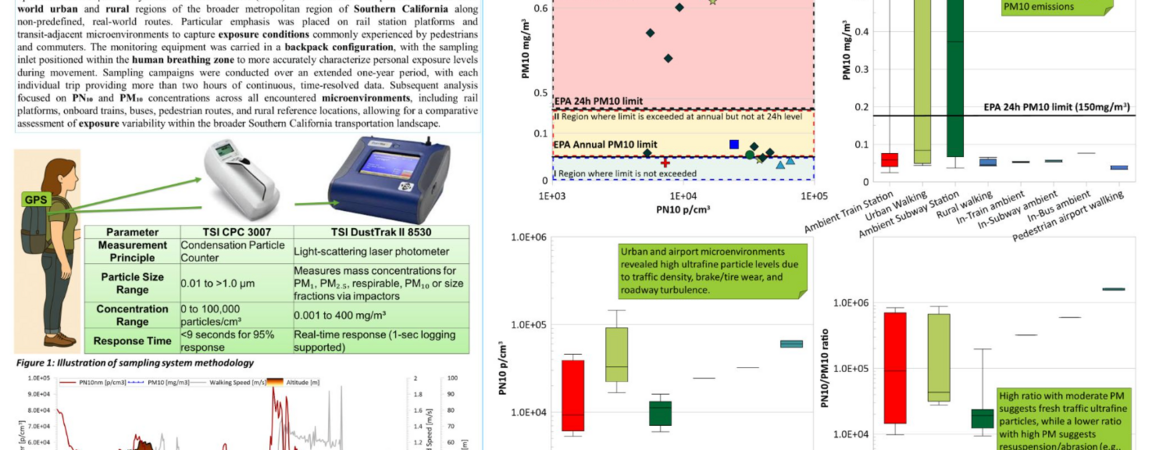
The research was conducted by CE-CERT Assistant Research Engineer Dr. Zisimos Toumasatos and graduate student researcher Joudi Sawas, whose work focuses on transportation emissions, air quality measurement, and real-world environmental monitoring. Their study examined particle number (PN₁₀) and particulate matter mass (PM₁₀) concentrations across a range of real-world microenvironments, including rail station platforms, onboard trains and buses, airport pedestrian areas, urban walking routes, and rural reference locations. Using portable monitoring instruments positioned within the human breathing zone, the research captured time-resolved air quality measurements experienced by pedestrians and transit users during everyday travel activities.
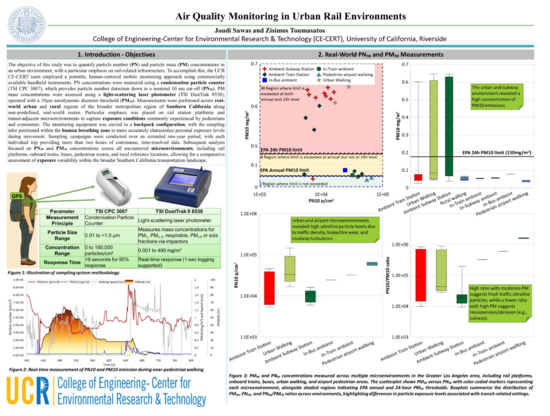
To conduct the measurements, the research team used a TSI CPC 3007 condensation particle counter to measure ultrafine particle concentrations and a TSI DustTrak II 8530 aerosol monitor for PM₁₀ measurements. Sampling campaigns were conducted over a one-year period across the greater Southern California metropolitan region, with each trip collecting more than two hours of continuous environmental data.
The study identified distinct differences in measured particle concentrations across transportation settings. According to the findings, subway and urban rail environments exhibited elevated PM₁₀ concentrations, while urban roadside and airport-related environments showed higher ultrafine particle concentrations associated with dense traffic activity, brake and tire wear, and roadway turbulence.
Researchers also analyzed the relationship between particle number and particulate mass measurements across environments. The findings suggest that higher PN₁₀-to-PM₁₀ ratios were associated with freshly emitted ultrafine particles commonly linked to traffic emissions, while lower ratios combined with elevated PM₁₀ concentrations were observed in environments where resuspension and abrasion processes may contribute more significantly to particulate matter levels.
The findings help illustrate how air quality conditions can vary significantly across the environments people move through each day. While traditional monitoring stations provide important regional air quality information, mobile monitoring approaches like this can help researchers better understand the conditions experienced directly by pedestrians and transit riders in real-world settings.
By examining how particle concentrations change across transportation environments, CE-CERT researchers aim to support broader efforts to improve urban air quality, inform sustainable transportation planning, and better understand the environmental conditions associated with everyday mobility in large metropolitan regions.
Let us help you with your search