Residents of San Pedro, Wilmington and Long Beach live near one of the nation’s busiest goods movement corridors, where oceangoing vessels move global trade through the ports of Los Angeles and Long Beach. For many families in nearby neighborhoods, the health and air quality impacts of port activity are ongoing concerns.
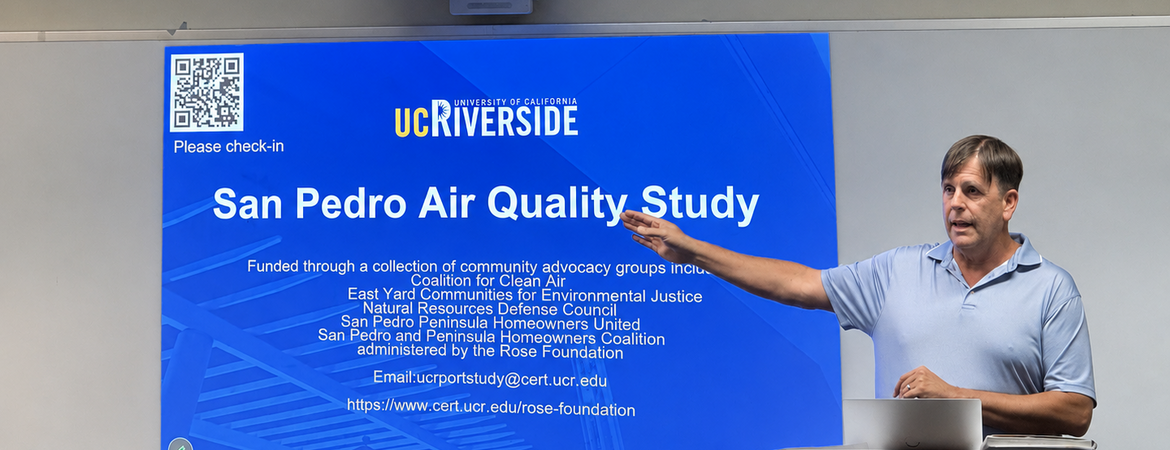
Those questions were at the center of a recent community meeting hosted by UC Riverside’s Bourns College of Engineering - Center for Environmental Research and Technology (CE-CERT) at the Boys & Girls Club of the Los Angeles Harbor in San Pedro. Residents joined in person and online to learn about a Rose Foundation-administered CE-CERT ship emissions study, ask questions and discuss concerns about pollution exposure and community air quality.
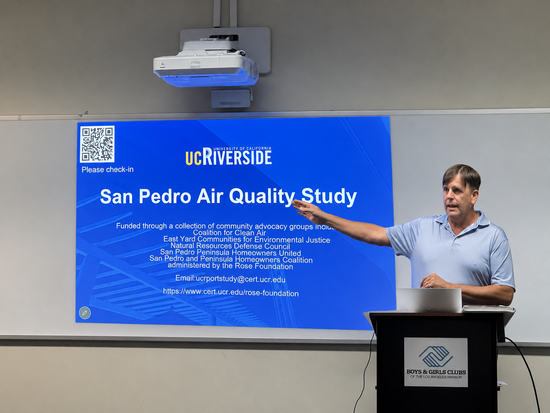
The study, “Tracking Ship Emissions from Source to Community,” examines how cargo ship emissions move through the atmosphere and contribute to air quality conditions in San Pedro and surrounding port-adjacent communities. Led by CE-CERT researchers, the work combines direct vessel testing, drone-based plume sampling, community air monitoring and atmospheric modeling to trace emissions from oceangoing vessels to nearby neighborhoods.
This work is funded through a coalition of community advocacy organizations, including the Coalition for Clean Air, East Yard Communities for Environmental Justice, Natural Resources Defense Council, San Pedro Peninsula Homeowners United, and the San Pedro and Peninsula Homeowners Coalition, and is administered by the Rose Foundation.
The project is led by David Cocker, professor of chemical and environmental engineering, with support from Don Collins, CE-CERT director and professor of chemical and environmental engineering; Thomas Eckel, project scientist; Kent Johnson, research engineer; and Will Porter, associate professor of environmental sciences and CE-CERT affiliate faculty.
The study is rooted in a long history of community advocacy around port pollution. According to Random Lengths News, mitigation funds from the China Shipping settlement are supporting the work, which aims to produce better real-time data on regulated pollutants, as well as information on hazardous air pollutants that have not been measured as consistently in port communities.
“We’re trying to take a holistic approach with this study,” Cocker said in an interview with Random Lengths News. “That’s kind of what’s unique.”
That approach is reflected in the study’s structure. Researchers will collect data at the source, in the air, in the community and through modeling, creating a more complete picture of how shipping-related emissions behave after they leave a vessel.
At the source, researchers will measure emissions directly from ship engines during real-world operations near the coastline. These measurements include nitrogen oxides, particulate matter and hazardous air pollutants such as carbonyls, aromatics and polycyclic aromatic hydrocarbons. The data will help build detailed chemical fingerprints of ship emissions across different engine types and operating conditions.
In the air, researchers will use a specialized drone platform to enter ship plumes and capture emissions as they move away from vessels. The drone-based approach is expected to allow researchers to measure far more ships than traditional onboard testing and expand the dataset to include 100 or more vessels over the course of the study.
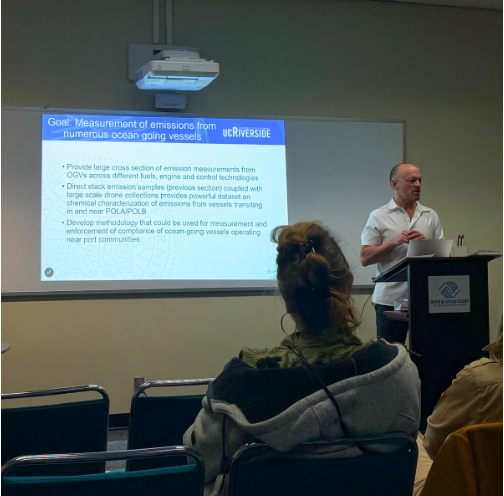
In the community, monitoring sites in San Pedro will measure local air quality over time. These sites will track particulate matter, black carbon, carbonyls, volatile organic compounds, polycyclic aromatic hydrocarbons and other chemical markers associated with ship emissions. The goal is to create long-term, place-based data that reflects neighborhood conditions.
Through atmospheric modeling, researchers will connect community air measurements back to their likely sources. By analyzing how air moves over time, the team can better distinguish between marine and land-based pollution and understand how shipping emissions influence local air quality.
A major focus of the study is low-speed ship operation near ports. While regulations have reduced emissions under many operating conditions, less is known about how ships perform at the low engine loads often used near shore. Due to the density of ship traffic in harbors, those emissions can significantly affect air quality in nearby port neighborhoods.
Port communities are exposed to many sources of pollution, including ships, trucks, trains and cargo-handling equipment. The study aims to help clarify how much pollution comes specifically from oceangoing vessels and how those emissions contribute to local air quality conditions.
The work also builds on earlier emissions research that helped regulators better understand diesel truck pollution near ports and congested transportation corridors. Similar research on ship emissions could help improve the data used in regulatory planning documents, which guide whether and how agencies develop new rules to reduce air pollution.
Joe Lyou, president and CEO of the Coalition for Clean Air, told Random Lengths News that CE-CERT’s research could help protect people in port-adjacent communities.
“New and cutting-edge research about ship emissions from the CE-CERT team could do a lot to help protect those who live, work, learn, and play in port-impacted communities,” Lyou said.
For CE-CERT, the San Pedro meeting marked an early step in sharing the research process with communities affected by port-related air pollution. Findings from the study are expected to be shared with residents, community organizations, media and regulatory agencies.
As the study moves forward, CE-CERT researchers will continue gathering data from ship engines, drone samples, neighborhood monitoring sites and atmospheric models. The findings could support future public health research, improve emissions inventories and provide community organizations and regulatory agencies with stronger evidence to guide air quality decisions.
The Rose Foundation-administered study reflects CE-CERT’s role as a research partner in service to communities. By combining advanced measurement tools, rigorous analysis and public engagement, the project aims to produce data that helps residents, advocates and decision-makers better understand how ship emissions affect air quality beyond the port.
Editor’s note: This story references reporting by Paul Rosenberg in Random Lengths News, which covered CE-CERT’s San Pedro community meeting and the study’s connection to the China Shipping settlement. Quotes from David Cocker and Joe Lyou are attributed to that coverage.
Let us help you with your search