-
CE-CERT Room 105
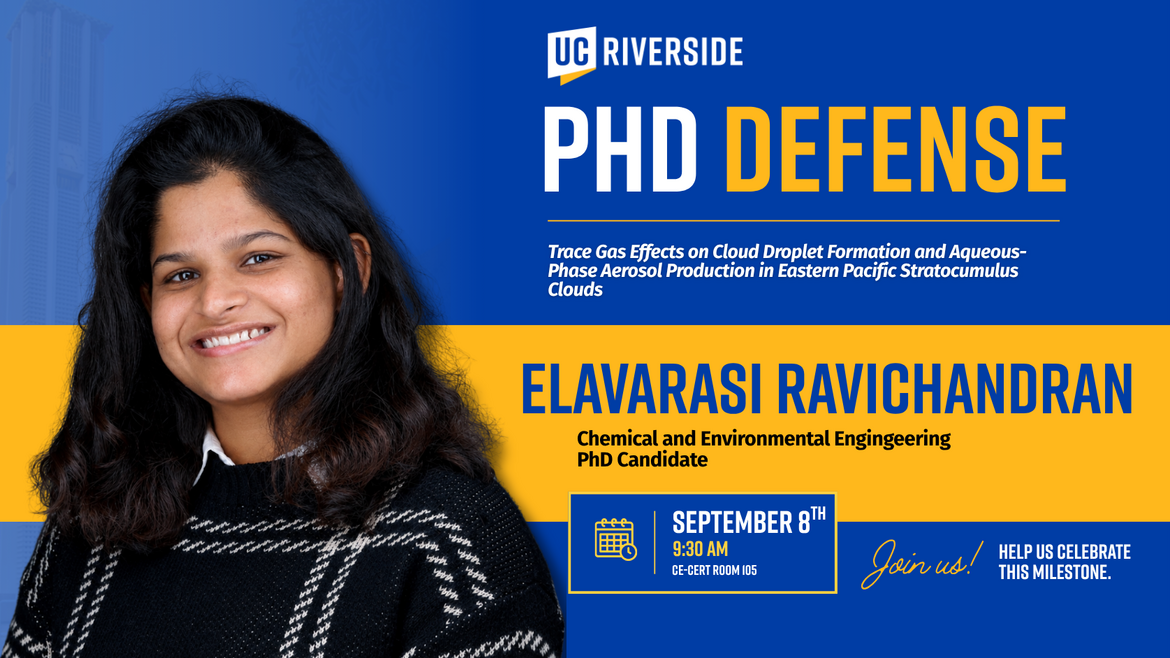
Elavarasi Ravichandran | Chemical and Environmental Engineering PhD Candidate
Time: 9:30 AM
Date: Tuesday, September 8
Location: Hybrid; CE-CERT RM 105 and Zoom (Meeting ID: 920 9387 0244 / Passcode: 331884)
Title: Trace Gas Effects on Cloud Droplet Formation and Aqueous-Phase Aerosol Production in Eastern Pacific Stratocumulus Clouds
Abstract: Atmospheric aerosols and clouds are closely coupled through interactions between the gas and particle phases and through aqueous-phase chemical processing. Aerosol measurements frequently include drying particles, which can remove semivolatiles compounds and modify their physicochemical properties, as well as the cloud condensation nuclei (CCN) activity. At the same time, cloud processing can form secondary inorganic and organic aerosols via aqueous-phase processes. Here, we investigate how gas-phase removal and in-cloud aqueous chemistry affect aerosol properties and CCN activity in Eastern Pacific stratocumulus clouds. Denuding organic trace gases may enhance or decrease particle hygroscopicity, with the direction and magnitude of the effect determined by relative humidity and trace gas concentrations. Aqueous-phase processing produced sulfate and organic aerosols rates ranging from 7 to 54 ng m–3 hr–1. During periods when in-cloud production was dominated by sulfate products, cloud processing resulted in an increase in the hygroscopicity of cloud condensation nuclei at 0.2% supersaturation. These findings show a strong relationship between gas-phase composition, aqueous-phase chemistry and aerosol properties, highlighting how cloud processing and trace gas interactions could influence aerosol-cloud interactions and their representation in atmospheric models.
Type
Events
Admission
Free
Let us help you with your search