-
CE-CERT Room 105
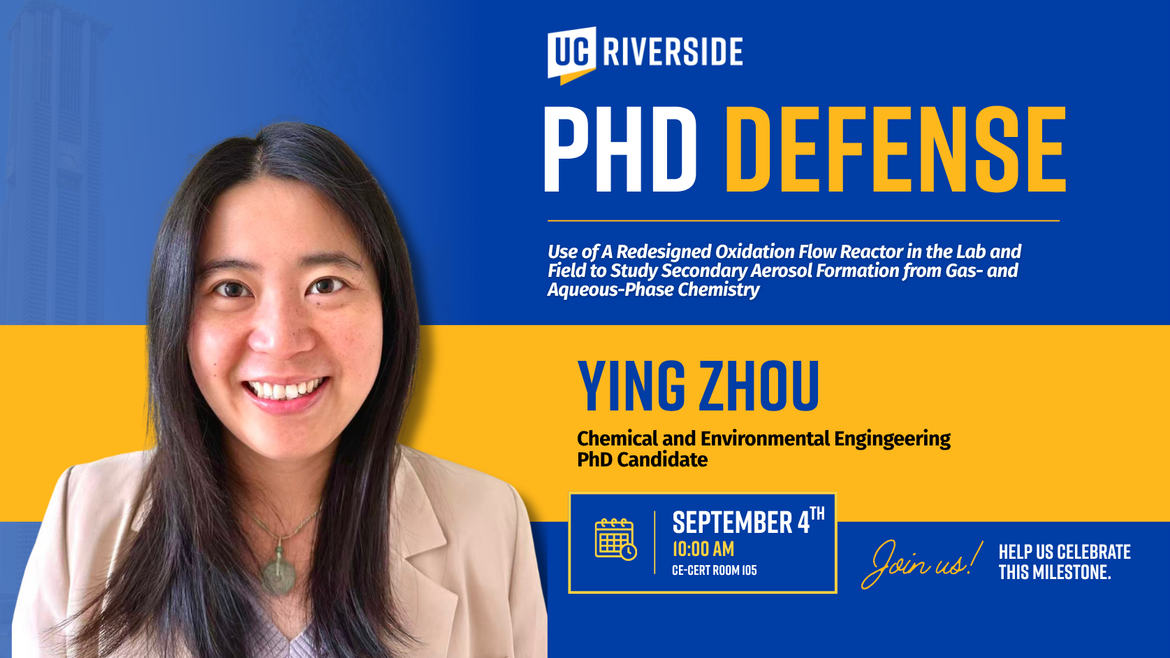
Ying Zhou | Chemical and Environmental Engineering PhD Candidate
Time: 10:00 AM
Date: Friday, September 4
Location: Hybrid; CE-CERT RM 105 and Zoom (Meeting ID: 991 8449 6937 / Passcode: 427546 )
Title: Use of A Redesigned Oxidation Flow Reactor in the Lab and Field to Study Secondary Aerosol Formation from Gas- and Aqueous-Phase Chemistry
Abstract: Fine particulate matter affects air quality, health, and climate, and much of it forms through atmospheric oxidation of gaseous precursors. Predicting secondary aerosol (SA) remains difficult because precursor mixtures, aging, and multiphase chemistry vary with location and atmospheric conditions. This dissertation used the Accelerated Production and Processing of Aerosols (APPA) oxidation flow reactor to examine the effects of OH exposure and aerosol water on SA formation in field and laboratory studies. The field project measured SA formation from particle-filtered ambient air during four campaigns in Riverside, Wilmington, and Bakersfield. The reactor was operated under dry-seed (DRY; 40% RH), aqueous-aerosol (AQ; 85% RH), and cloud-droplet (CLD; 100% RH) conditions at low and high OH exposures. Secondary organic aerosol (SOA) formation generally increased with OH exposure and water content, although the dominant influence varied by site. Riverside responded mainly to water; at Wilmington, organic aerosol responded primarily to OH exposure and nitrate to water; and Bakersfield was influenced by both factors. Higher OH exposure and water content generally increased f 44 and decreased f 43 , indicating more oxidized organic aerosol compositions.
These site-dependent responses indicate that SA formation from local precursor mixtures differs in its sensitivity to OH exposure and aerosol water content; however, the lack of speciated gas- phase precursor measurements limits attribution of these differences to specific sources. The laboratory project examined SA formation from dimethyl selenide (DMSe) and dimethyl diselenide (DMDSe), with dimethyl sulfide (DMS) included as a sulfur analogue, under low- and high-NO x conditions. All three precursors produced measurable SA, and AQ yields consistently exceeded DRY yields. Under CLD conditions, yields decreased with OH exposure. Together, the mAMS fragment distributions and CIMS formula assignments indicated progressive oxygenation, formation of single-Se products, and possible Se-C and Se-Se bond cleavage. Eight selected Se-containing formulas were identified by CIMS in the gas and particle phases. These results show that aerosol water content and oxidative aging influence their partitioning between the gas and particle phases. Interpretation is limited by model-estimated precursor consumption, different OH-exposure ranges between the low- and high-NOₓ regimes, and the inability of mAMS and CIMS measurements to identify unique molecular structures.
Type
Events
Admission
Free
Let us help you with your search