-
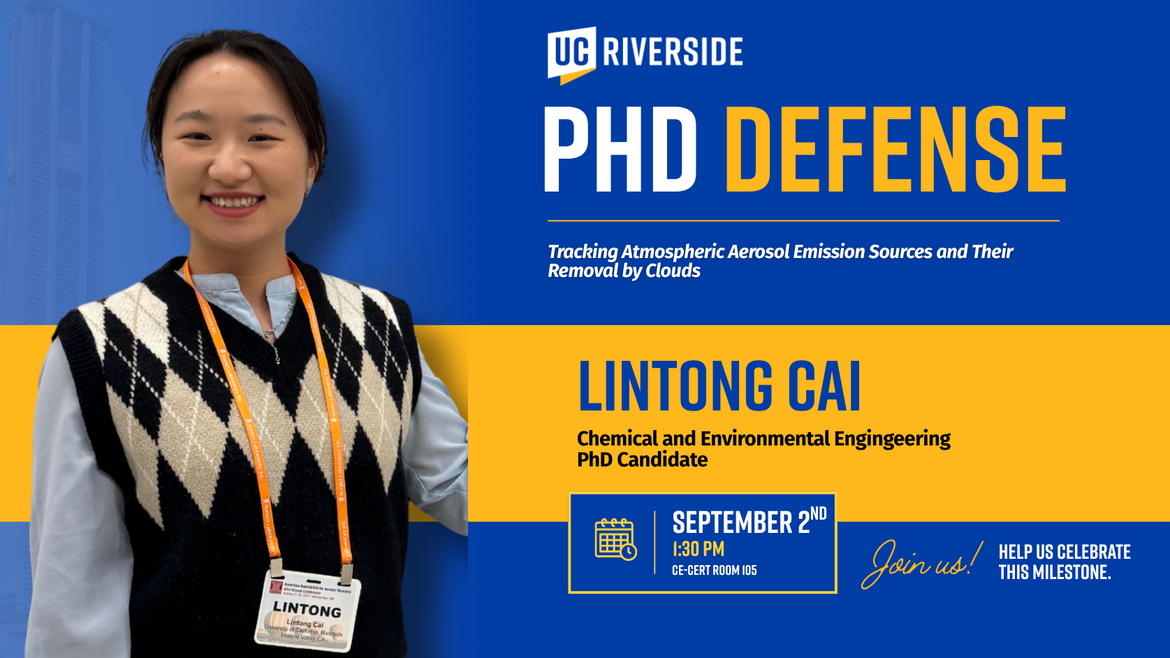
CE-CERT Room 105
Lintong Cai | Chemical and Environmental Engineering PhD Candidate
Time: 1:30 PM
Date: Wednesday, September 2
Location: Hybrid; CE-CERT RM 105 and Zoom (ID: 987 6570 3757 / Passcode: 720738)
Title: Tracking Atmospheric Aerosol Emission Sources and Their Removal by Clouds
Abstract: This thesis seeks to better understand the emissions, fate, and environmental impact of atmospheric particulate matter between 3 nm and 3 μm in a range of environments. The fundamental research tools applied include transmission electron microscopy, mobility particle size spectrometers, optical particle size spectrometers, and incandescence detection of refractory black carbon. The first project investigates nanoparticle emission near a wastewater facility and an adjacent composting facility. Repeated and persistent episodes of elevated particle number concentrations were observed downwind from a facility, frequently exceeding 200,000 cm−3 for particles between 5 and 20 nm in mobility diameter. These particle numbers generally correlated with CO2 levels. Emission factors ranged from 4.4 × 10¹⁴ to 3.7 × 10¹⁵ kg−1 CO2. Transmission electron microscopy analysis shows that particles composed primarily of carbon, with some sulfur, nitrogen, and phosphorus. Agglomerated morphology suggests either solid or highly viscous phase states. The observed elevated number concentrations align with particle generation via gas-phase nucleation, likely triggered by high volatile organic compounds emissions from the facility. Approaching aircraft near Ontario International Airport in Southern California is another major source for sub-10 nm particles. Observations of time series representing individual plumes of 1 to 5 min duration show peak plume concentrations > 105 cm−3. When the plume number concentration exceeds 100,000 cm−3, the mode diameter is 8.2 ± 1.7 nm and 66.9% ± 16.9% of particles have diameters less than 10 nm. Large-eddy simulations demonstrate rapid downward mixing of exhaust plumes and persistent elevated concentration near the surface.
The second project investigates aerosol properties observed in the Cold Air Outbreak Experiment in the Sub-Arctic Region campaign. The airborne measurements covered a wide vertical range, from the near-surface (≤ 500 m) to the free troposphere (> 2 km) across remote regions between Scandinavia and the coast of Greenland. A merged particle distribution product, spanning from 10 nm to 3 µm in diameter, was developed combining a suite of five aerosol sensors. Number closure was achieved between the different instruments. Estimated aerosol number concentration from the merged size distribution varied between ~50 and ~700 cm−3. Refractory black carbon concentrations (70-900 nm) varied between ~1.2 and ~74 ng m−3. Aerosol mass concentration observations were compared to the NASA Goddard Earth Observing System composition forecast (GEOS-CF). The model concentrations correlated with the observations, indicating agreement with the spatial and temporal distribution of localized black carbon aerosol plumes. Case studies of research flights with quasi-Lagrangian trajectories during cold air outbreak events offer a unique opportunity to disentangle the contributions of entrainment, coalescence scavenging, and particle production within the cold-air outbreak (CAO) marine cloud regime. The apparent scavenging rates were characterized for black carbon, Aitken mode, accumulation mode, and coarse mode aerosol using the aerosol budget model. Local aerosol scavenging rates in CAO clouds significantly exceed aerosol production by sea spray. Our results demonstrate that the rate of aerosol recharge provides a limit on the cloud fraction over the larger domain. Combined, these studies will help to better constrain aerosol sources and their fate in the atmospheric environment.
Type
Events
Admission
Free
Let us help you with your search