-
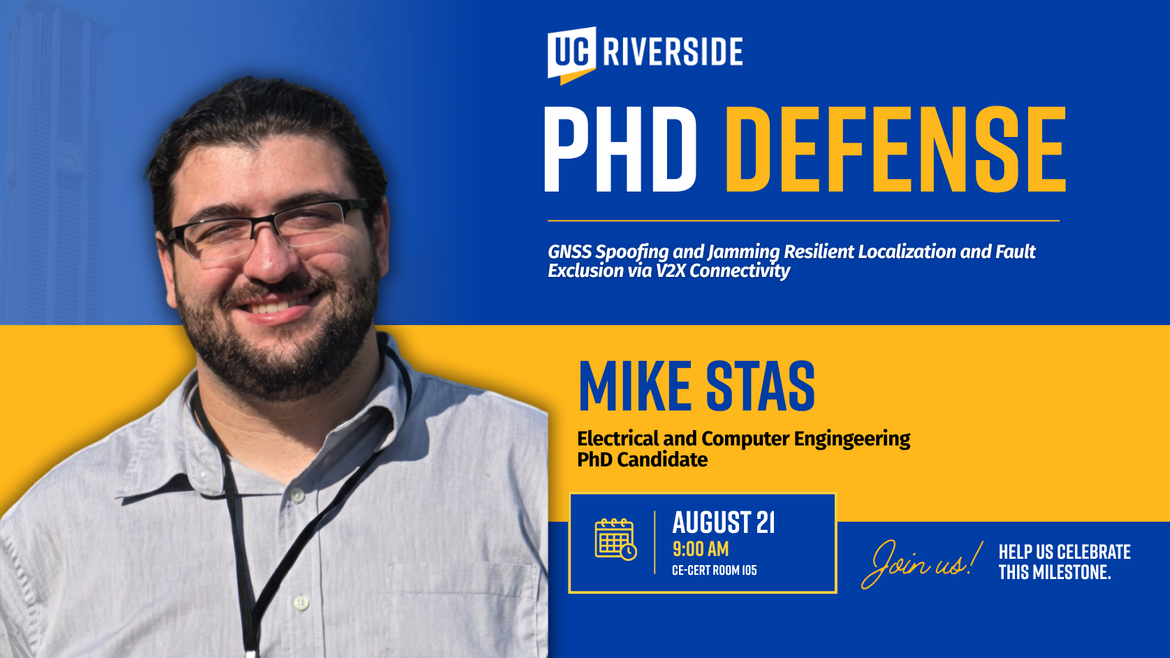
CE-CERT Room 105
Mike Stas | Electrical and Computer Engineering PhD Candidate
Time: 9:00 AM
Date: Friday, August 21
Location: Hybrid; CE-CERT RM 105 and Zoom (Meeting ID: 944 0828 9139 )
Title: GNSS Spoofing and Jamming Resilient Localization and Fault Exclusion via V2X Connectivity
Abstract: Connected and automated vehicles (CAVs) rely on the Global Navigation Satellite System (GNSS) for positioning, synchronization, and vehicle-to-everything (V2X) timing, yet GNSS is vulnerable to spoofing and jamming. Spoofing can produce false but internally consistent solutions that evade GNSS-centric integrity checks. CAVs carry independent modalities such as LiDAR, inertial sensing, and wheel odometry that can expose these faults, but are not generally incorporated into GNSS integrity monitoring. This dissertation bridges these domains by bringing integrity monitoring into the multi-sensor CAV setting. A data-dependent hidden Markov model and real-time sliding-window Viterbi decoders provide lane-level map matching that exceeds 95% accuracy and degrades gracefully as GNSS quality deteriorates. A cooperative framework compares GNSS/INS-derived inter-vehicle distance exchanged over V2X with an independent LiDAR measurement; in a two-vehicle field experiment, all eight anomaly alerts were driven by the LiDAR-based comparison while the GNSS/INS solutions remained mutually consistent. Finally, a tightly coupled factor-graph estimator fuses GNSS, inertial, LiDAR, and wheel-odometry measurements with GNSS-independent scan-to-map matching, evaluated using data collected from a real CAV platform. In a cross-session evaluation, an integrity layer built on this backbone detects and responds to injected GNSS spoofing by isolating affected measurements and repairing the trajectory, achieving 1.63 m horizontal RMS error. Together, these contributions bring the integrity discipline of satellite navigation into the broader sensor environment of the connected and automated vehicle, moving CAV localization from trusting GNSS to verifying it.
Type
Events
Admission
Free
Let us help you with your search