CE-CERT has completed two major research efforts under the OMEGA initiative, Objective Measurement/Monitoring/Mitigation of Emissions from Goods Movement and Impacts on Air Quality, that together provide the most comprehensive assessment to date of how freight activity affects air quality and community health in Inland Southern California. This work, conducted by a multidisciplinary CE-CERT team, including Matthew Barth, Kanok Boriboonsomsin, Peng Hao, Kent Johnson, Thomas Durbin, William Porter, Yejia Liao, and Lynne Xu, in collaboration with partners at the Coalition for Clean Air, represents one of the region’s most ambitious attempts to collect real-world emissions data, deploy neighborhood-scale air quality monitoring tools, and evaluate practical mitigation strategies for freight-impacted communities.
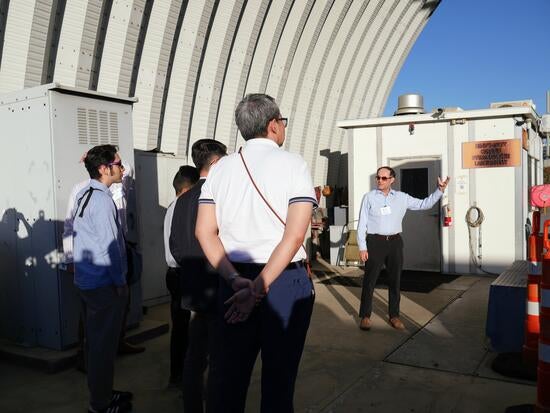
To address the lack of real-world emissions information, the team instrumented more than 40 heavy-duty trucks across multiple fleets with CE-CERT’s upgraded Onboard Sensing, Analysis, and Reporting (OSAR) emissions monitoring system and collected additional measurements from over 10,000 in-use trucks using two state-of-the-art remote sensing platforms. These combined datasets revealed that modern diesel and natural gas engines equipped with advanced aftertreatment systems achieve substantially lower in-use nitrogen oxides (NOx) emissions than earlier generations, highlighting the importance of continued fleet turnover and adoption of ultralow-emitting technologies.
Recognizing that regional air quality monitors overlook hyperlocal impacts, CE-CERT deployed indoor and outdoor air quality sensors at six community host sites, generating neighborhood-level data on fine particulate matter (PM2.5), NOx, ozone, and other pollutants. This monitoring captured clear diurnal and seasonal patterns, underscoring the need for more localized exposure assessment in communities situated near freight activity.
By integrating these measurements into a sophisticated traffic-emissions-air-quality modeling framework, the team evaluated how freight flows affect pollution exposure at both the street and community scale. Mitigation strategies such as strategic designation of truck routes, low-exposure routing, and increased deployment of electric trucks showed strong potential to reduce community exposure to truck emissions and improve neighborhood air quality. For example, low-exposure routing consistently lowered pollutant concentrations near sensitive receptors, and a 30% penetration of electric trucks in the fleet produced an approximate 10% reduction in average NOx concentrations across modeled areas.
Together, these studies establish a robust, data-driven foundation for designing healthier and more efficient freight networks in Inland Southern California. The work was supported primarily by the Automobile Emissions Research and Technology Fund administered by the California Attorney General’s Office, with additional support from the South Coast Air Quality Management District, the California Air Resources Board, the Center for Healthy and Efficient Mobility, as well as the funding from Highland Fairview, the City of Moreno Valley, and the Moreno Valley Community Services District administered by the Riverside County Transportation Commission.
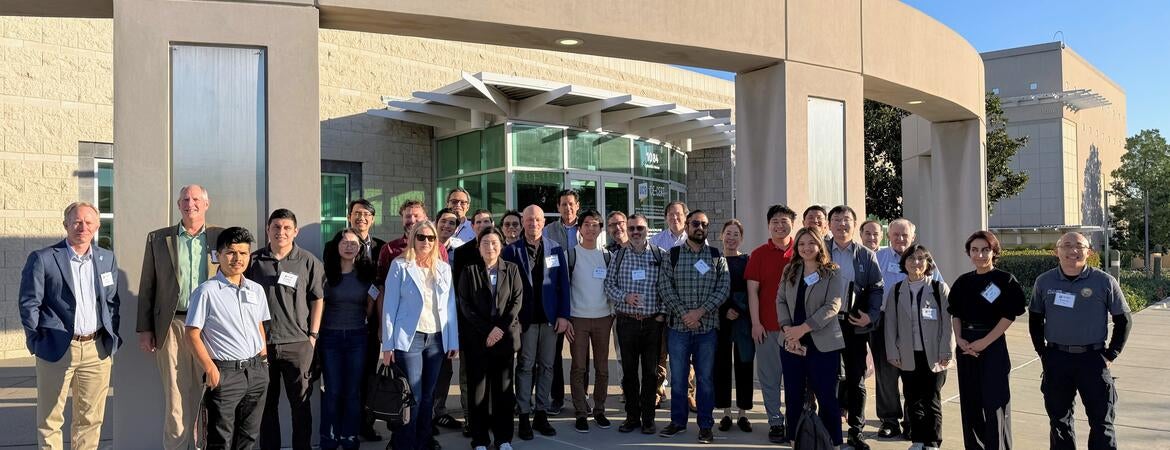
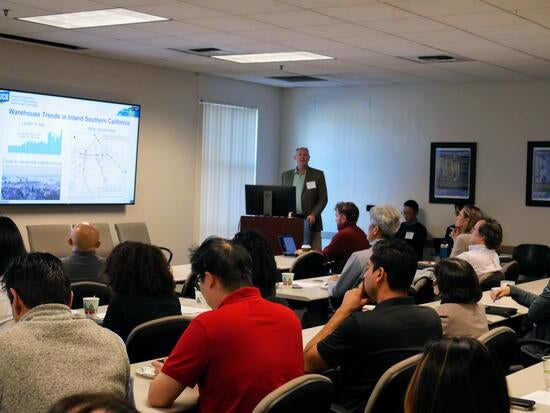
The OMEGA Dissemination Workshop, held on December 11, brought together more than 50 state, regional, and local agency leaders and policymakers. During the event, CE-CERT researchers presented key findings, demonstrated newly developed modeling tools, and facilitated discussions on how these insights can guide future planning and regulatory strategies that protect public health while supporting efficient goods movement. The strong turnout and active engagement reflect the region’s readiness to apply data-driven approaches to freight emissions challenges.
Let us help you with your search