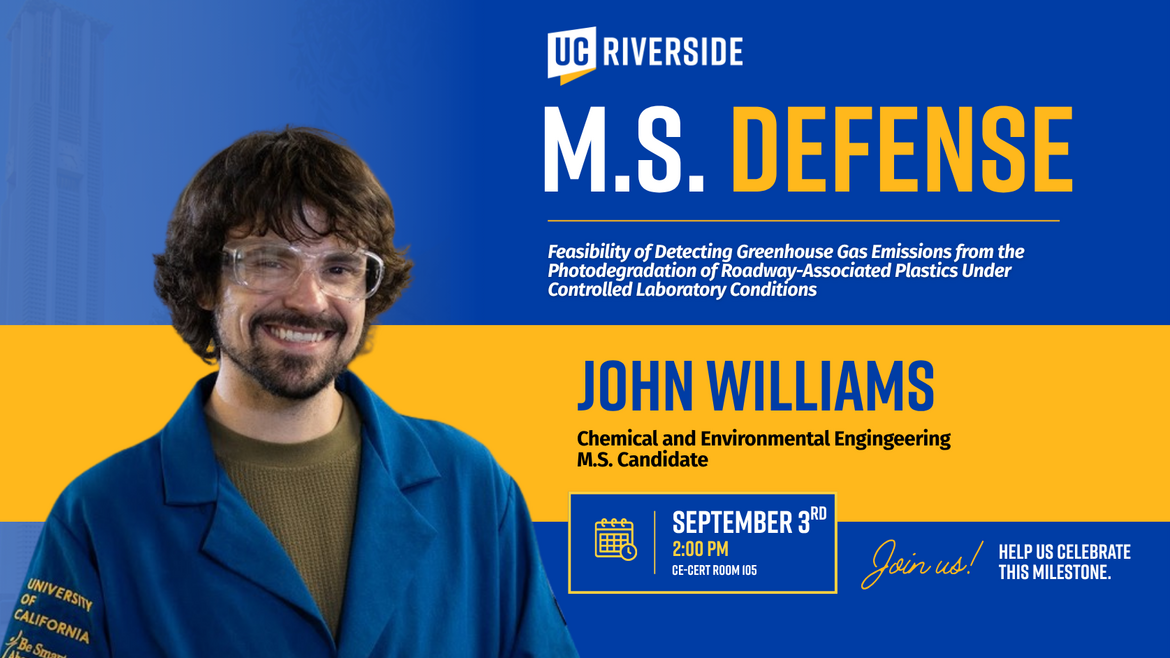
-
CE-CERT Room 105
John Williams | Chemical and Environmental Engineering M.S. Candidate
Time: 2:00 PM
Date: Thursday, September 3
Location: Hybrid; CE-CERT RM 105 and Zoom (Meeting ID: 913 1672 9655 / Passcode: 704370)
Title: Feasibility of Detecting Greenhouse Gas Emissions from the Photodegradation of Roadway-Associated Plastics Under Controlled Laboratory Conditions
Abstract: Roadway-associated plastic debris represents a pervasive environmental contaminant along transportation corridors, yet its direct contribution to atmospheric greenhouse gas emissions remains poorly quantified. This thesis addresses critical research gaps regarding roadside polymer degradation by transitioning from traditional static batch methodologies toward a real-time, dynamic laboratory Proof of Concept (PoC). Utilizing a 1 ft3 transparent acrylic reaction chamber coupled with continuous zero-air sweep flows and an inline dual-analyzer array (Agilent 6890N GC-FID and LI-COR LI-840a), roadway plastic samples collected across Southern California were evaluated under both controlled laboratory UV arrays (350 nm peak intensity) and natural ambient solar radiation.
Continuous gas chromatography monitoring yielded no detectable methane or light hydrocarbon (C1-C4) emissions above baseline ambient levels (1.85-2.11 ppm). While low-level carbon dioxide (CO2) increases were detected, baseline characterization revealed that direct connection to facility clean-air lines introduced severe diurnal CO2 fluctuations swinging up to ~500 ppm over 24 hours. Decoupling the reactor using an isolated Teflon ballast reservoir stabilized background signals within ±5 ppm, isolating trace substrate emissions from background analytical noise.
Under a conservative bounding scenario assuming a maximum 10 ppm ∆CO2 increase across a 1 LPM flow rate, the upper-bound daily emission yield was calculated at 0.001135 g CO2/day. Comparing this to U.S. EPA vehicle standards shows that a single light-duty passenger car traveling just one mile emits CO2 equivalent to over 960 years of continuous upper-bound photodegradation from a roadside plastic sample. Furthermore, scaling this upper bound to statewide roadside litter estimates (1170 kg/km accumulation rate; 56% plastics across 175,818 miles of California public roads) yields a total emission rate of 207.7 metric tons of CO2 per day. The cumulative yearly total (75811 metric tons) accounts less than 0.125% of annual emissions from California’s 13.2 million registered passenger vehicles.
These empirical metrics strongly suggest that photolytic gas production from plastic polymer breakdown is functionally trivial within regional climate inventories. Consequently, state transit entities like Caltrans can shift regulatory focus away from atmospheric carbon offset modeling. Instead, environmental strategies should focus on mitigating physical macro- and microplastic fragmentation, controlling chemical leachate dispersal, and enhancing roadside litter collection efficiency.
Type
Events
Admission
Free
Let us help you with your search