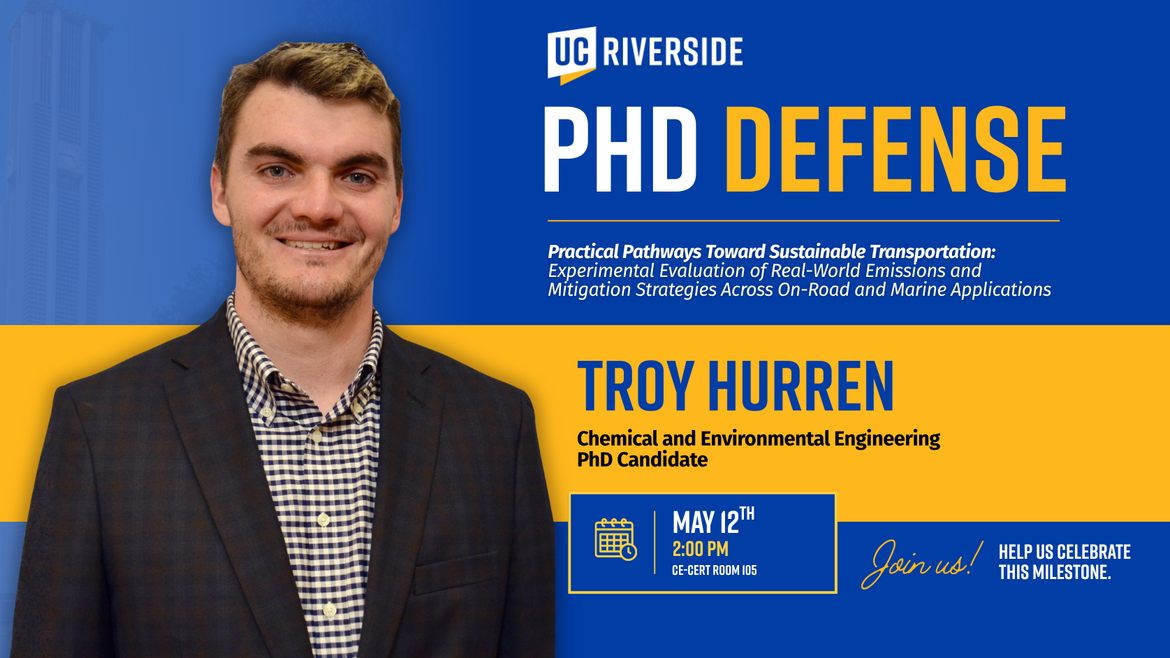
-
CE-CERT Room 105
Troy Hurren | Chemical and Environmental Engineering PhD Candidate
Time: 2:00 PM
Date: Tuesday, May 12
Location: Hybrid; CE-CERT RM 105 and Zoom (ID: 91027001912 Passcode: 853435)
Title: Practical Pathways Toward Sustainable Transportation: Experimental Evaluation of Real-World Emissions and Mitigation Strategies Across On-Road and Marine Applications
Abstract: The internal combustion engine (ICE) remains critical to global transportation, yet is a major source of greenhouse gas (GHG) and criteria air pollutant emissions. While battery-electric vehicles offer a long-term pathway to reduced emissions, obstacles such as driving range, charging infrastructure, and costs still persist and highlight the need for near-term advanced technologies and low-carbon fuels. This dissertation addresses practical emissions reduction and characterization across seven interrelated studies spanning heavy-duty, light-duty, and maritime sectors. In-use NOx data from 63 heavy-duty vehicles showed current diesel and natural gas technologies already meet future EPA standards. A modified inventory model representing a best-case-scenario projected reductions of 91.9% by 2050 without full electrification. Hydrogen-enriched renewable natural gas blends in an unmodified heavy-duty engine improved thermal efficiency and reduced CO2 for both steady-state and transient behavior, but elevated NOx above 5% hydrogen without recalibration. A novel renewable naphtha-ethanol blend reduced PM, NOx, and secondary aerosol from a light-duty vehicle while delivering life cycle CO2 benefits. Real-world ammonia measurements from 25 light-duty gasoline vehicles identified catalyst aging and fuel-rich transients as dominant drivers, with inventory models underestimating fleet contributions. Barge-based capture and control systems at California ports exceeded 90% NOx, PM, and reactive organic gas reduction from ocean-going vessels, benefiting disproportionately affected port communities. This volume of work provides analytical and critical information for engine manufacturers, fuel suppliers, and policymakers to make informed decisions on practical pathways toward more sustainable transportation that can be realized immediately across heavy-duty, light-duty and marine applications.
Bio: Troy Hurren is a Ph.D. candidate in Chemical and Environmental Engineering at the University of California, Riverside. His research focuses on the measurement and characterization of combustion-related emissions primarily from mobile sources, with an emphasis on real-world operating conditions. Troy has also completed a six-month industry co-op with Cummins Inc., and is a recipient of the National Science Foundation Science to Policy Education: Activating Knowledge for Sustainable Transportation (SPEAKS) Fellowship, which focuses on bridging the gap between science and regulation. Troy holds a Master’s of Applied Science in Mechanical Engineering degree from the University of British Columbia and a Bachelor’s of Science in Mechanical Engineering degree from Mississippi State University.
Type
Events
Admission
Free
Let us help you with your search